Conversion from waste to
energy carrier

Electricity
and Thermal Energy from Waste – Waste-to-Energy Plants Electricity energy from wastes
The
integration of waste-to-energy our technologies offers significant
environmental and economic benefits, but the advancements in pyrolysis using
microwave technology represent a leap forward in this field. Additionally, the
localized production of energy from waste fosters community resilience and
economic growth by creating jobs and utilizing local resources. Our technology
enables the efficient conversion of waste into valuable energy carriers while
minimizing harmful emissions. This method addresses some of the most critical
environmental concerns by eliminating nitrogen oxides and significantly
reducing carbon dioxide and other toxic emissions.
Who We Are – A Global Developer of Waste to Power Infrastructure • We are an international engineering group
focused on building utility-scale waste-to-energy plants for municipalities and
industrial partners worldwide. • Our mission is to transform the rapidly
growing volume of municipal waste into stable, baseload electricity, creating
long-term value for cities, communities, and investors. • As the burden on landfills increases and energy
systems become more vulnerable, our projects offer a resilient alternative: we
convert local waste into local energy, reducing environmental impact while
strengthening energy independence. • We
provide end-to-end industrial implementation—covering engineering and
manufacturing, plant construction, grid integration, and long-term operation.
• Our power plants generate electricity
24/7, regardless of weather conditions, and create new economic opportunities
wherever they are deployed. • For
investors, this represents a future-proof infrastructure platform built on a
guaranteed feedstock, predictable revenue, and global scalability.
The population of our planet is
constantly growing, so
the amount of waste generated is also constantly growing,
which can be used to generate electricity. Solar and wind energy are our ideal
energy sources, but we also need to deal with waste, because it is slowly
covering our planet. Electricity covers all our energy needs, there is
no need for oil and coal, we can cook with electricity in the kitchen, use
electric cars, cool and heat our homes.
We
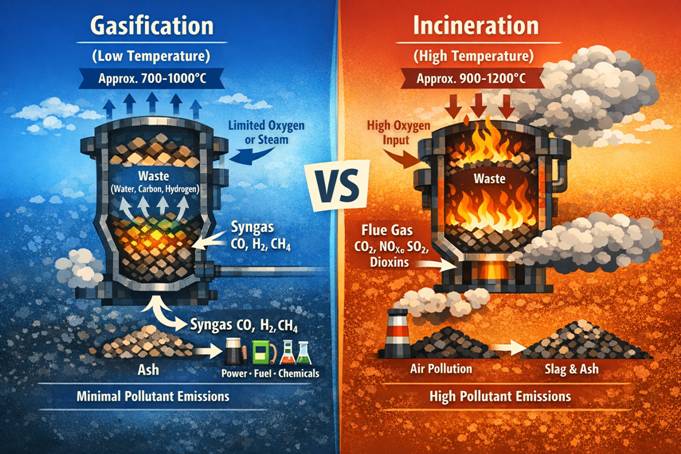
build power plants that use syngas from tires and RDF as fuel for gas turbines.
Our entire gasification process does not produce pyrolysis oil, coal dust, oil
sludge, wastewater. Syngas is NOx-free, CO2 emissions are reduced. The
synthetic gas produced is the fuel for gas turbines. There is
no water consumption, so it can be used in desert environments, where drinking
water is still a great value. Our goal is to provide the population of their
settlements with locally produced energy from locally generated and locally
collected waste, creating local jobs.
Europe is entering a new
strategic phase
- One of the
most significant challenges facing the European Union is the
management of non-recyclable waste streams, the reduction of dependence on
fossil carbon sources, and the production of sustainable energy carriers.
The European Green Deal, the Circular Economy Action Plan, the initiative
on sustainable carbon cycles, and the industrial carbon management
strategy all support the utilization of secondary carbon sources and the
development of a circular economy.
- Microwave-excited
steam
plasma can create a non-equilibrium
plasma-chemical environment that opens up new reaction pathways for the
conversion of carbonaceous waste and refuse-derived fuel (RDF), thereby
enabling the production of high-added-value synthesis gas (syngas). The
project’s long-term vision extends beyond conventional waste recovery. The
development demonstrates the conversion of syngas derived from waste into
methanol, allowing the energy stored in the waste to be utilized in the
form of a transportable energy carrier. Waste → Microwave steam
plasma → Synthesis gas → Methanol → Transportable energy
carrier → Local electricity generation
- A key
innovation of the project lies not only in the
potential for methanol production but also in the ability to decouple the
energy derived from waste—both in space and time—from the location where
it was generated. This could lay the foundation for the development of
new, decentralized energy systems. Current gasification technologies are
primarily based on conventional thermal systems, fluidized-bed reactors,
entrained-flow technologies, and plasma-arc solutions.
- Non-recyclable
waste is transformed into a secondary carbon
source, which can serve as a basis for creating transportable energy
carriers, chemical feedstocks, and decentralized energy generation
systems. Waste should be viewed not merely as a residual material
requiring disposal, but as a strategic carbon source for the European
circular economy—a resource from which energy, sustainable fuels, and
industrial raw materials can be produced.
- "Green"
methanol derived from PET and plastic waste is no longer just a burden; it serves as a secondary
carbon source for the production of high-value industrial products that
are free from fossil-based materials. Our corporate group has developed a
globally unique innovation for the production of green methanol, green
hydrogen, and green ammonia. A further strategic advantage of the system
is its ability to operate in "island mode"—completely
independently of the external electricity grid. This ensures that the
final product is truly green methanol.
- PET-based green
methanol—a strategic breakthrough in waste-to-energy
technologies. Due to its high hydrogen and carbon content, PET serves as
an exceptionally valuable feedstock for the production of green methanol,
which is a form of liquid green hydrogen.

The waste should not be a
burden, but a green energy resource..
The waste should not be a burden, but a green
energy resource..
1. Turning Waste Into Value: Clean Energy and Green Molecules • Our technology converts mixed waste (RDF) into clean synthesis gas. • This gas contains two key components: hydrogen (H₂) and carbon monoxide (CO). • Synthesis gas is one of the world’s most important industrial feedstocks, • used to produce electricity, fuels, and chemical products.
2. From Synthesis Gas to Methanol: The synthesis gas is passed through catalysts, producing methanol. • Methanol is a globally traded, easily stored, and easily transported liquid energy carrier. Why is this valuable? High energy density: ~22.7 MJ/kg • The carbon in the waste becomes a valuable product, not pollution • Methanol production is a stable, well established industrial process
3. Hydrogen From Methanol — Exactly Where It Is Needed: Methanol or ammonia can be easily converted into high purity hydrogen.
Why is this pathway exceptional? 3 tons of RDF → ~1 ton of carbon → ~2 tons of
methanol → ~375 kg hydrogen → ~2 tons ammonia
•
This yields 4× more hydrogen than direct gasification of waste • Methanol is
a liquid hydrogen carrier: no high pressure, no cryogenic storage, simple
logistics
4. Complete Value Chain — From Waste to Green Hydrogen or Green Ammonia:
RDF → Methanol → Green Hydrogen → Green Ammonia From the synthesis gas (H2 ~65% CO2 ~30%) produced from waste,• we can generate electricity, methanol, or ammonia.• Both methanol and ammonia act as liquid hydrogen carriers,• delivering large quantities of hydrogen exactly where it is needed.
From the same waste stream:
4–8× higher economic value — delivered as premium quality green methanol.
Our gasification technology
transforms the world’s largest untapped raw material — waste — into one of the
most sought after energy carriers of the green industrial transition. This
represents the next multi billion euro opportunity in the clean energy sector.
Profitability — percentage comparison: Electricity: 100% •
Green hydrogen: +641–731% • Green methanol: +1 172–1 577% →
Green methanol is by far the most profitable configuration.
Why is this an exceptional investment opportunity?
1. High value product — premium global pricing. Green methanol is the liquid equivalent of hydrogen:
hydrogen rich, easily transportable, and in explosive demand due to maritime
decarbonization. Global demand for methanol will triple by 2035. → The
same waste stream generates significantly higher revenue than electricity
production.
2. Immediate market demand — shipping is already
transitioning: Maersk, CMA CGM, and
Evergreen are deploying methanol powered fleets. EU and IMO regulations mandate
a rising share of green fuels by 2030. → The market is ready; demand is
real and accelerating.
3. Autothermal, self sustaining operation — minimal OPEX The entire process is powered by the waste itself. No
external electricity. No fossil feedstocks. No grid dependency. → High
EBITDA margins, predictable cash flow, low operational risk.
4. Global scalability — waste exists everywhere RDF is available worldwide, and green methanol is globally
tradable. → Exportable, modular, industry agnostic business model.
5. Decentralized, circular energy — ESG premium Carbon remains within the circular loop. Fully aligned with
EU Taxonomy, RFNBO, and e fuel standards. → Low regulatory risk,
access to green funding, higher valuation multiples.
Investor highlights:
Low CAPEX relative to
industrial scale • Minimal OPEX due to self generated
energy • Outstanding profit margins •
Extremely short payback period → Green methanol is the highest
value output from the same waste stream. A new global energy category Decentralized, carbon neutral, circular green methanol from
waste defines the future of clean energy — and the next multi billion euro
market.

PET-based Green Methanol – A Strategic Breakthrough in Waste-to-Energy Technologies
PET is no longer mere waste; it is
a strategic raw material. With its high hydrogen and carbon content, it serves as one
of the most valuable feedstocks for the production of green
methanol—essentially liquid green hydrogen. Our microwave- and
steam-plasma-assisted gasification technology converts PET into synthesis gas
(syngas) and subsequently into methanol with world-class efficiency, far
outperforming conventional waste-to-fuel systems.
⚙️ Technological
Performance
2 tons of PET → 1.8–2.2 tons
of green methanol ➡️ 350 kg of hydrogen ➡️ 2.4 tons of green
ammonia. PET carbon residue: 55–60% carbon content → exceptional syngas
yield ➡️ World-leading performance in plasma-based
gasification
💶 Revenue Model
(€/ton of PET)
Methanol: €720–880. CO₂
credits: €260–310 ➡️ Total revenue: €980–1,190 per ton of PET. 1 ton of
methanol sequesters approximately 1.37 tons of CO₂ → stable revenue
from carbon credits, fully compliant with EU regulations.
🔌 Operating
Expenses (OPEX) – Extremely low
Energy self-sufficient operation:
the reactor generates all the electricity required for its own operation.
Steam: €50–75 Catalyst
depreciation: €50–75
Maintenance: €100–150 ➡️ Total OPEX: €200–300 / tonne of PET
📈 Profitability
➡️ €680–890 profit / tonne of PET. One of the highest
profitability levels globally in the field of waste-based methanol production.
🏭 Industrial
Module (10,000 tonnes of PET/year)
Methanol output: 18,000–22,000
tonnes/year
Annual revenue: €9.8–12.1 million
Annual profit: €6.8–8.9 million
➡️ A single module generates €6–9 million in profit
per year.
🌍 Why is this
important?
Energy self-sufficiency →
minimal operating expenses (OPEX)
Revenue from the sale of
EU-compliant CO₂ allowances
PET waste is transformed into a
liquid green hydrogen carrier
Provides a solution for waste
management, green hydrogen production, and CO₂ capture
Microwave steam-plasma reactor →
no need for catalysts or electrodes → world-leading innovation

Professional assessment of
the concept.
1. “We deliver green energy; we generate electricity
exactly where it is needed.”
We create a new global energy
category: mobile green energy supply, delivering premium margins. Instead of
producing electricity at a fixed location and selling it at regulated, low
prices, we convert waste into green methanol — a high value liquid fuel that
can be transported anywhere using standard logistics. This enables a location
independent revenue model: we sell energy not where it is produced, but where
its market value is highest — ports, mines, data centers, industrial zones,
islands, construction sites. At the destination, methanol is converted into
electricity via fuel cells, providing real time, controllable power without
grid dependence. This flexibility significantly increases the commercial value
of energy units.
2. “Our technology is a breakthrough in waste utilization:
we do not produce low value electricity from waste (RDF), but green methanol.”
Traditional WtE plants generate low
margin electricity tied to local tariffs. Our technology converts RDF into
green methanol — a globally traded product with stable pricing and strong
demand. This shift unlocks multiple profit streams: methanol is a premium
industrial feedstock, • the fastest growing green fuel in shipping, • a stable, transportable hydrogen
carrier, • seamlessly integrated into global chemical
supply chains. In short: we upgrade waste into a high value product, instead of
producing low value utility electricity. This is the foundation of the business
model’s profitability.
3. “From the same of RDF… we produce green methanol with
4–8× higher economic value.”
Our system converts the same RDF
into green methanol, whose market value is 4–8× higher, because: methanol
contains hydrogen,
• hydrogen rich fuels
sell at premium prices, • methanol is globally traded, •
shipping decarbonization is rapidly increasing demand. This means the
same waste stream generates multiple times the revenue, independent of local
electricity markets. For investors, this delivers: higher gross margins, •
predictable cash flow, • global scalability.
4. “At the destination… green methanol is fed into a high
efficiency fuel cell.”
Fuel cells convert methanol into
electricity with exceptional efficiency and full controllability — ideal for
customers needing reliable, locally produced green energy. These include: ports
(shore power), • mines (off grid operations), •
data centers (backup + peak shaving),
• industrial parks, •
construction sites, • islands, •
military bases. These sectors represent billions of dollars of
unmet demand for clean, on demand energy. By selling methanol instead of
electricity, we enter global industrial fuel markets — not local utility
markets — creating major profit advantages.
5. “The entire process is energetically self sufficient.”
Our system generates all required
process energy from the RDF itself. This autotermic design eliminates: external
electricity costs, • fossil fuel use, •
exposure to volatile energy prices,
• dependence on local
infrastructure. For investors, this means: low OPEX, •
high EBITDA margin,
• predictable operating
costs, • strong resilience to market fluctuations.
Energy self sufficiency is one of the model’s strongest economic advantages.
6. “Carbon stays in the cycle — real environmental value.”
Instead of releasing carbon into
the atmosphere, our process binds it in methanol, keeping carbon within the
circular system. This enables: measurable CO₂ reduction, •
compliance with EU and global ESG frameworks, •
access to green financing,
• premium positioning in
sustainability driven markets. For investors: • access to green funds, •
lower regulatory risk, • higher valuation multiples due to ESG
alignment.
7. “This is the future of decentralized, carbon neutral,
circular energy production.”
Our platform sits at the
intersection of three global megatrends: Decentralized energy – industries need
local, controllable green power. • Circular economy – waste becomes feedstock for
high value fuels. • Green industrial transition – methanol is
becoming the global standard for clean fuels. Their convergence creates a multi
billion dollar global market opportunity. We are not merely building a plant.
We are creating a scalable, exportable, globally significant, high profit
energy and fuel production platform
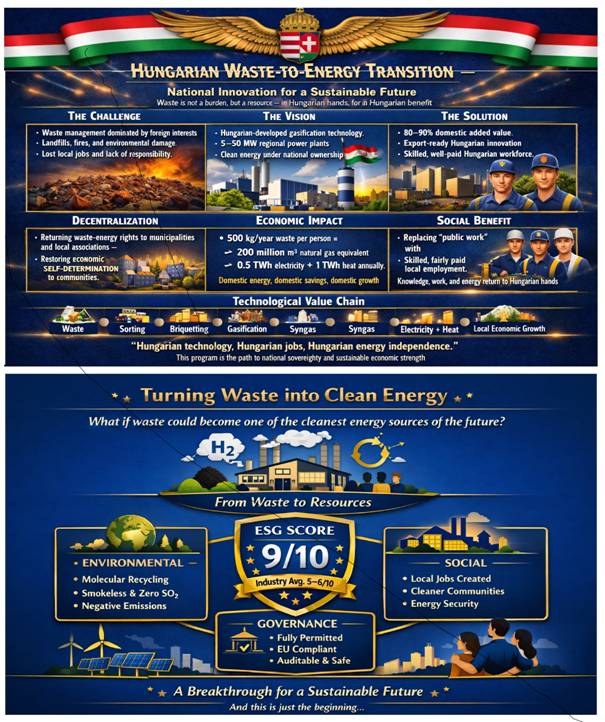
Our global novelty is the
green hydrogen technology from our residential and tire waste,
Which is a Hungarian development, not only "better" than existing solutions - it
represents a completely new category on the global market. Below is a precise
summary of what constitutes the true novelty and why no comparable integrated,
catalyst free, grid independent hydrogen platform exists today.The Current Global Landscape — and Why Others Cannot Do
What You Can. Today, the global market is dominated by three technological
pathways:
(A) Water Electrolysis (PEM, Alkaline, SOEC) • 50–65 kWh/kg H₂ electricity demand • Fully grid
dependent • Water demand: 9–12 L/kg H₂ • Cannot utilize waste as
feedstock ➡ Technically
and energetically not an alternative to your system.
(B) Catalytic Gasification / Reforming (Ni, Fe, Co
catalysts) • Tar formation → catalyst
poisoning • Rapid deactivation due to chlorine and sulfur • Slag formation →
reactor blockage• 800–1100°C, but not plasma ➡ Your catalyst free microwave plasma solution is in a
completely different league.
(C) Plasma Waste Treatment (face plasma, torch plasma) • 3000–5000°C, but electrode based • Electrode erosion →
high OPEX • Not optimized for hydrogen production • No
autonomous energy loop ➡ Your 915MHz
microwave, electrode less plasma is unique worldwide.
There is currently novelty (Global Level) no technology
that can produce hydrogen: from RDF, • without catalysts, • using electrode less microwave
plasma, • with a fully autonomous energy cycle, • at 99.999% purity, • with
28–34 kWh/kg specific electricity demand, • without water and without grid
connection.

Climate protection with
green coal, a biochar
We design and manufacture biochar carbonizers from 2
tons/day – 50 tons/day,
Climate
protection with green coal, a biochar-
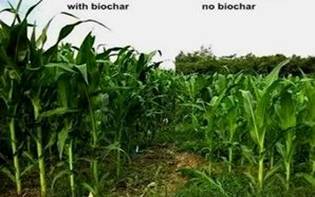
Biochar is an excellent substitute for soil strength, it is more than a fertilizer
e.g. the corn stalks grown on
Biochar
composition from harvest waste C 77.58%, Volatile matter 12.92%, SiO2 3.5%, Al2O3 1.9%, CaO
1.9%, K2O 0.1%, Na2O 0.5%, Fe2O3 0.75% , MgO 1.3%. , P2O5 0.17%) Biochar
produced from animal bone is a high-calcium phosphate and low-carbon apatite
mineral product, which is a macroporous and slow-dissolving natural organic
P-fertilizer. Hydroxyapatite with a high phosphorus content is mostly composed
of an inorganic mineral and a carbon component.
Biochar can
improve the composting process and improve
itself at the same time. Reducing nitrogen loss during composting is a notable
benefit when compost is supplemented with biochar. The highly absorbent surface
of biochar, on the other hand, is "charged" with humic acids, plant
nutrients and living microorganisms.
Nutrient
conservation. Plant nutrients are released
into the ground water through leaching and into the air through evaporation.
This means a decrease in the economy's efficiency and, beyond the fence, an
environmental problem. Nutrient pollution is one of the most widespread, costly
and challenging environmental problems caused by excess nitrogen and phosphorus
in air and water.

The efficiency of the fertilizer improved significantly
after the application of biochar. This was primarily observed as a reduction in
the loss of plant nutrients. Like charcoal used for filtration, biochar (a type
of charcoal) can help trap plant nutrients in the soil. However, it is
important to note that most of the nutrients stored in the biochar are still
available to the plant it resists loss, yet can be used. Mixing biochar
directly into compost for a single co-product application maximizes the nutrient
retention benefits of biochar.
Water retention. Where biochar has been applied, soils show
higher water holding capacity, better water retention, increased plant
available water, increased plant resilience in drought conditions, and
increased productivity per unit of water. The yield benefits of adding biochar
to agricultural practices in the case of irrigation, the expected result is a
reduction in the amount of water needed,
Source: EBC (2012) ‘European Biochar Certificate –
Guidelines for a Sustainable Production of Biochar.’ European Biochar
Foundation (EBC), Arbaz, Switzerland. http://www.european-
biochar.org/en/download. Version 6.3E of 14th August 2017, DOI:
10.13140/RG.2.1.4658.7043
Biochar
patterns
tree twig, chicken litter, straw, corn stalk, furniture wood
waste…
The
recommended amount is 4t/ha on hard soil, 8t/ha on sandy desert areas
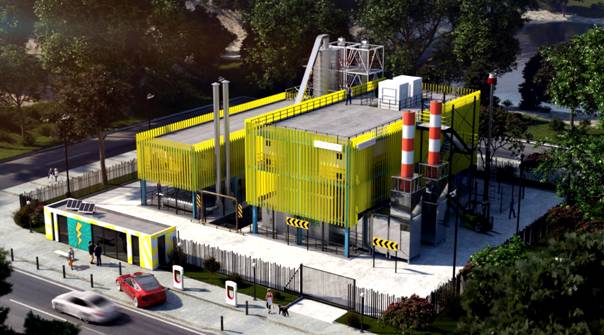

Sample plots for comparative measurement of yield

Thanks for watching

Jozsef Nagy
Machine manufacturing technologist
Microwave emitters - steam plasma torch specialist
contact: gumienergia@gmail.com
mobil: +3620 338 2107
My philosophy
My philosophy is, never be jealous
of others' success. If you can't win a race, help the one ahead of you break
the record. Your candle doesn't lose its light by lighting another. Let's
follow this example of supporting and lifting each other up! This is a
beautiful philosophy! Supporting and lifting others not only helps them
succeed, but also creates a positive and encouraging environment for everyone.
It's like spreading kindness and positivity, which can make a big difference in
the world." 
